BGP (Border Gateway Protocol)
- TCP port 179
- Path vector protocol (list of AS on path to the network)
- eBGP AD: 20
- iBGP AD: 200
- Loop prevention mechanism is AS_PATH attribute (if own AS in list, discard)
- Triggered updates (only when something changes)
Message Types
| Type | Description |
|---|---|
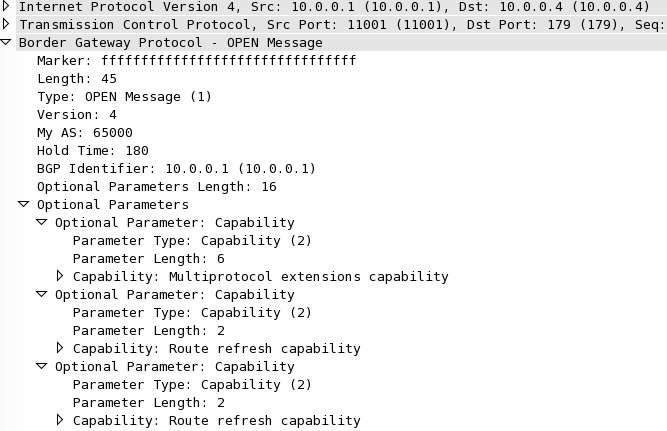
| Open | Attempt to establish peering - includes AS#, router ID, hold time. TCP 179 |
| Keepalive | Keeps peering active. 60 seconds default (Cisco) |
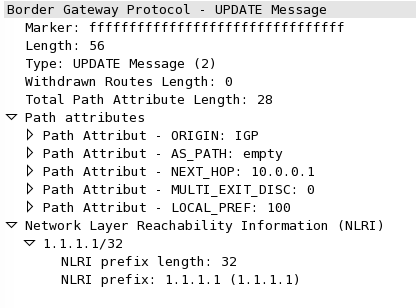
| Update | New routes; withdrawn routes ; path attributes |
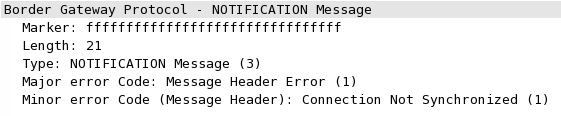
| Notification | Sent when problem occurs. Connection closed when received |
BGP States
| Type | Description |
|---|---|
| Idle | Searching for neighbors |
| Connect | TCP 3-way handshake complete w/ neighbor |
| Open Sent | BGP Open message has been sent (displayed as "active") |
| Open Confirm | Response received (displayed as "active") |
| Estabished | Neighborship established |
Synchronization
Requires that when a BGP router receives information about a network from an iBGP neighbor, it does not use that information until a matching route is learned via an IGP or static route
Generally prevents traffic from being forward to unreachable destinations
Reasons to turn off synchronization: - All routers in AS running BGP - All BGP routers are meshed - When not a transit AS
Router(config-router)# no synchronization
Split Horizon (iBGP)
- Routes learned from iBGP are never propagated to other iBGP peers (unless you use route reflectors)
Next-hop
- When a router receives an update from eBGP, it must pass the update to its iBGP neighbors without changing the next-hop attribute.
- To change this behavior on the edge of an AS, use
next-hop-self
Excellent link on BGP next-hop processing
- BGP next hop is set to routers own address on EBGP sessions
- Next-hop is not changed on iBGP sessions
- Route reflectors cannot change BGP next hop of reflected routes
Attributes
| Name | Category | Description |
|---|---|---|
| Origin | Well-known Mandatory | IGP / EGP / Unknown. iBGP (i) < eBGP (e) < incomplete (?). Origin IGP = network statement, incomplete = redistributed into BGP. |
| AS Path | Well-known Mandatory | List of AS's traversed. Prefer shortest. |
| Next Hop | Well-known Mandatory | External peer in neighboring AS. Not used in path selection |
| Local Preference | Well-known Discretionary | Metric for internal neighbors to reach destinations (default 100 - Cisco) |
| Atomic Aggregate | Well-known Discretionary | Includes ASes which have been dropped due to route aggregation |
| Aggregator | Optional Transitive | Id and AS of summarizing router |
| Community | Optional Transitive | Route tag |
| MED (Multiple Exit Discriminator) | Optional Nontransitive | Metric for external neighbors to reach the local AS (0 default) |
| Originator Id | Optional Nontransitive | Originator of a reflected route (identifies route refector) |
| Cluster List | Optional Nontransitive | List of cluster IDs (loop prevention for reflected routes simiar to AS_PATH) |
| Cluster ID | Optional Nontransitive | Originating cluster (route reflector) |
BGP Route Selection Process
- Select only the routes whose next hop is reachable.
- Select route with highest WEIGHT [ Cisco Specific and Local on the router]
- Select route with highest LOCAL PREFERENCE [Local within an AS, default is 100]
- Select Locally originated Routes (Self sourced routes into BGP are preferred)
- Select Shortest AS Path
- Select Lowest Origin Code: IGP > EGP > Incomplete( Route with a ?)
- Select Lowest MED (shown as metric in
sh ip bgpcommand). Used externally to enter an AS. - Select EBGP routes over IBGP routes
- Select Smallest IGP metric to next-hop.
- Select Oldest Route (Age) - Does not apply to iBGP routes
- Select neighbor with Lowest Router ID
- Select Lowest Interface IP address if the router-id is the same.
Multi-hop
Example for peering between loopbacks for EBGP:
router bgp 65000
  ebgp-multihop 2
  update-source loopback 0
!
ip route 3.3.3.3 255.255.255.255 172.12.123.2
Example Configs
router bgp 100
  network 3.3.3.3 mask 255.255.255.255
  neighbor 172.12.123.2 remote-as 200
Setting default local-pref (globally):
router bgp 100
  bgp default local-preference 100
Summarization:
- Without
summary-onlymore specifics are advertised in addition to the summary aggregate route
router bgp 5
  aggregate-address 16.0.0.0 252.0.0.0 summary-only
  network 16.0.0.0 mask 255.0.0.0
  network 17.0.0.0 mask 255.0.0.0
  network 18.0.0.0 mask 255.0.0.0
  network 19.0.0.0 mask 255.0.0.0
Peer-Groups:
router bgp 100
  neighbor MyAS peer-group
  neighbor MyAS remote-as 100
  neighbor 10.1.1.1 peer-group MyAS
  neighbor 10.1.1.2 peer-group MyAS
Source address:
neighbor 10.1.1.2 update-source loopback0
Authentication:
neighbor 10.1.1.2 password c1sc0
Route-Reflector:
Specify clients on the route-reflector router
(config-router)# neighbor 172.1.1.1 route-reflector-client
Route Reflectors
- Updates from RR clients are sent to all client and non-client peers
- Updates from ebgp peers are sent to all client and non-client peers
- Updates from non-client peers are sent to all clients
Prefix Lists
- Have implicit deny
- Auto-increment by 5 in IOS
- Verify with
show ip prefix-lists
ip prefix-list BLAH deny 16.0.0.0/8
ip prefix-list BLAH permit 0.0.0.0/0 le 32
router bgp 100
  neighbor 172.12.123.2 prefix-list BLAH out
Examples/explanations:
10.0.0.0/24 le 30 will match 10.0.0.0/24 and all prefixes contained therein with a length of 30 or less

0.0.0.0/0 le 32 matches any prefix with a length between 0 and 32 bits inclusive

10.0.0.0/8 ge 16 le 24 will match all prefixes within the 10.0.0.0/8 network having a mask both a) greater than or equal to 16 bits, and b) less than or equal to 24 bits in length
Private ASNs
64496-65535
Adding to an existing list:
ip prefix-list BLAH seq 9 deny 55.55.55.55/32
Commands
show ip bgp neighbor
show ip bgp summary
show ip bgp
show ip bgp 3.3.3.3
Miscellaneous Notes
- eBGP packets have a TTL of 1 (reason for
ebgp-multihop) - "Soft" resets require
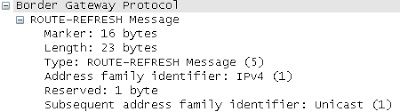
soft-reconfiguration inbound, which keeps an unprocessed copy of neighbor updates. Requires more memory. Does not tear down BGP session or flap. - Route refresh capability can request neighbor re-advertise all routes. Negotiated in Open message exchange. Cannot use soft-reconfiguration simultaneously on Cisco with route-refresh.
- When advertising routes with the
networkcommand, it must be an exact match for a network in the RIB. Usemaskor the match is classful. - Always check route to the next-hop if a route is not showing as
validinshow ip bgp. - Router ID is the highest IP loopback, or highest IP of an up interface. Can be manually set with
(config-router)# bgp router-id 1.1.1.1. Changing the router-id drops adjacencies.
Design notes
- IBGP sessions configured between loopback addresses and EBGP sessions configured across directly connected subnets (best practice)
Sample packets
Open:
Update:
Keepalive:

Notification:
Route Refresh: