IS-IS
- Transport: layer 2 (ISO)
- Type: Link-state (dijkstra SPF algorithm)
- Metric: Default(10)
- Administrative distance: 115
- Protocols: IP, CLNS
-
"Integrated IS-IS": IP Support
-
Network layer protocol in OSI is CLNP (connectionless network protocol) and is used for CLNS (connectionless network service)
Routing Levels
- Level 0: Used to Locate End Systems
- Level 1: Routing intra-area
- Level 2: Routing inter-area
- Level 3: Inter-AS (IRDP)
Router types
- Level 1: Routes to networks intra-area. Keeps one LSDB. Uses default route to nearest level 2 router for traffic destined outside the area
- Level 2: Routes inter-area. Routing is based on area ID. Keeps one LSDB for routing to other areas
- Level 1-2: Acts as a gateway between level 1 and 2. Keeps 2 LSDBs.
IS-IS Adjacency States
- Down: No hellos received from neighbor
- Initializing: Received hellow but not sure if neighbor has received local router's hellos
- Up: Confirmed neighboring router received local router's hellos (two-way)
Terminology
| Term | Description |
|---|---|
| ES | End System; host/computer |
| IS | Intermediate System; Router |
| Circuit ID | Physical interface on router |
| ISH | Intermediate System Hello; Sent by routers to hosts |
| IIH | IS to IS hello; Sent between routers |
| LSDB | Link state database ; keeps seperate LSDB for each area |
| LSP | Link state PDU ; A routing update |
| NET | Network Entity Title ; A routers NSAP. The last byte of the NET is always zero |
| TLV | Type length value ; Fields in ISIS LSP ; support multiple protocols (extensibility) |
| NSAP | Network Service Access Point ; address of a CLNS device; one per device |
| NSEL | Last byte of a NSAP ; NSAP Selector; Identifies process on the device (routing) |
| PRC | Partial Route Calculation ; used to determine ES and IP subnet reachability |
| CSNP | Complete Sequence Number PDU ; a summary of routers complete LSDB |
| PSNP | Partial Sequence Number PDU ; acks receipt of a CSNP |
| SNP | Sequence number PDU ; sequence number helps maintain recent link state info |
| SNPA | Layer 2 UD (MAC or DLCI) |
Comparison with OSPF
- Described as "OSPF using only totally stubby areas"
Differences vs OSPF
- No central backbone area
- Operates at data-link layer vs OSPF which runs over IP
- Uses a single designated router (called designated IS [DIS]) and different timers
- OSPF has interfaces in seperate areas. IS-IS is wholly in a level 1 area, or level 1-2 routers are in one area at level 1 and another area at level 2.
- DIS simulates a point-to-point topology to a LAN. DIS exists seperately at level 1 and level 2. It allows preemption. IS-IS adjacencies formed with every router but LSP sent only by DIS on behalf of the pseudonode
- TLVs enable new protocols to be quickly added. OSPF needs OSPFv3 to support things like IPv6. IS-IS implements a new TLV for IPv6
Addressing
49.0001.1111.1111.1111.00
- 49 designates private area addressing
- 49.0001 is the area ID
- 1111.1111.1111 is the system ID (must be unique). System MAC for example
- 00 is the NSEL. Router is always set to 00
A NET is an NSAP with the NSEL set to 00
Adjacency Requirements
- Interface MTU must match
- Levels must match
- Areas must match (if Level 1)
- System IDs must be unique
- Authentication must succeed if configured
-
Hello and Hold timers must match
-
Level 1 forms with L1 and L1-2 in the same area
- Level 2 forms only with Level2 capable devices (L2 or L1-L2)
Network types
Only recognizes broadcast and point-to-point links.
- Hello and dead timers are 10/30 on both network types
Broadcast Network
- DIS sends out hellows ever 3.3 seconds (3 times speed of other routers)
- If a router with higher priority appears it is elected the DIS (can also occur if DIS fails)
- DIS election based on highest priority interface, then highest MAC/DLCI. Highest system ID breaks tie. Default priority is 64. There is no priority 0 option like in OSPF to keep a router from becoming the DIS.
- DIS sends out updates using a multicast MAC
Point-to-Point Network
- No DIS exists on a point-to-point link
- After hellos received, each side sends a CSNP
Operation
- Routes refresh timer is 15 minutes (if still in database after 20 minutes, assume originator has died)
Update
- Triggered updates generate LSPs (adjacency change, link flap, route changes, etc.)
Decision
- Will install multiple equal-cost paths
- Level 1 paths prefered over level 2
- Longest match
-
If no path in database, send to nearest level 2 router (default router)
-
Metric is called "Default". Set to 10 for all interfaces on Cisco routers and is the only metric supported (delay/expense/error are others)
- "Narrow" metrics (6-bits) on outgoing interface are the default
- "Wide" metrics increased to 24-bits. Helps better distinguish between paths
Forwarding
Receiving
Routing inter-area
- When sending to a destination not in routing table, an L1 router will send traffic to the nearest Level 1-2 router. The Level 1-2 router uses its routing table to route it across level 2 to the nearest level 1-2 router advertising a matching summary.
- Level 1-2 introduce a default route back into level 1
- For level 2 updates to be exchanged, all routers capable of sending Level 2 updates must be contiguous
-
Borders in IS-IS are defined on the link
-
Overvation: L1 node makes default route to L1-L2 when it receives an LSP with an "ATT" (attached) bit set. The L1-L2 router must be attached to another area for this to happen
Packet Samples
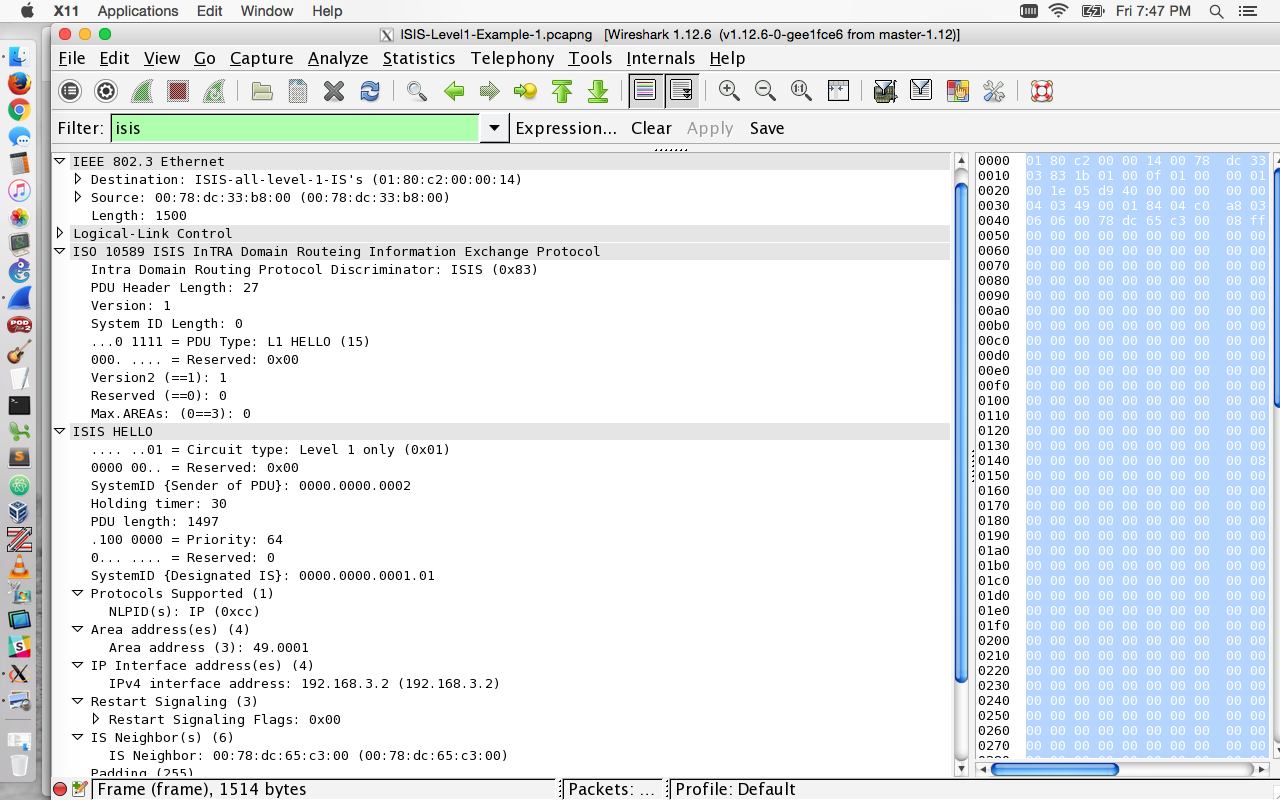
IS-IS HELLO: